
FAQ
Does the NVR require an Internet connection to use the AI Assistant function?
Yes. The AI Assistant function operates through a web interface integrated with the OpenAI API. Therefore, the NVR requires an Internet connection to enable this feature.
Besides AI Assistant, what other AI functions are available?
In addition to the AI Assistant, the NVR also supports other AI features, including:
- Face Recognition
- Fall Detection
These AI functions require an additional Hailo AI module.
Do you provide cameras equipped with illumination features?
Yes. We provide cameras equipped with dual-light technology, including IR infrared and white-light illumination.
When an event is detected, the camera can switch to white-light mode and activate flashing illumination to provide an active warning effect.
In addition, selected models feature a built-in speaker, enabling enhanced audio and visual deterrence functions. Compared with solutions that only provide dual illumination and microphones, our models with built-in speakers offer a more complete active deterrence solution, providing a competitive product advantage.
Is it possible to customize the Web GUI and assist with dedicated APP development?
Yes. The Web GUI can be customized according to your requirements. The Web interface provides the same user experience and operating interface as the local NVR interface, allowing users to operate the system consistently whether accessing it locally or remotely.
Customized APP development services are also available. Please provide your requirements so we can evaluate the feasibility of the customization project. If you prefer to develop the APP independently, we can provide relevant technical documents, including API / SDK, for system integration and development. We can also discuss the most suitable cooperation model based on your requirements.
How do the camera / NVR and mobile devices establish a connection?
The mobile APP primarily connects directly to the NVR. The following connection methods are supported:
- UID (P2P)
- Public IP (Port Forwarding)
- DDNS Domain
Currently, we do not provide a Cloud Server architecture.
In addition, both our front-end and back-end platforms are independently developed. Device communication can be established through our private communication protocol or the ONVIF standard protocol.
We currently use a Cloud Server for initial device pairing, then switch to P2P, with setup completed through QR Code. We would like to integrate with your Cloud Server in the future. Is this possible?
We need to further understand your requirements before evaluating the integration feasibility. Please confirm the following:
- Are you planning to integrate the IP Camera or the NVR into your Cloud Server?
- Could you provide a Demo Site or related technical documents (API / Protocol Specification) for our evaluation?
After reviewing the technical documents or testing environment, we will evaluate the integration feasibility and provide further recommendations.
Are your cameras C-Mount or CS-Mount compatible?
Our cameras use fixed lenses and are not designed with C-Mount or CS-Mount interfaces.
The specification indicates a 1/2.8" sensor. Does this mean it uses the Sony IMX415 sensor?
The image sensor varies depending on the camera resolution:
- 8MP Camera: Sony IMX415
- 5MP Camera: Sony IMX335
We provide 5MP and 8MP Bullet and Dome cameras equipped with 2.8–12mm Auto Focus lenses, which can automatically adjust the focal length according to different monitoring distances to improve face recognition performance.
Generally, CS-Mount lenses are commonly used in applications where the distance between the camera and the recognition target varies significantly, or where precise control of face size within the image is required to ensure recognition accuracy.
For these requirements, we provide the following solutions:
- The NVR firmware supports configurable Face Recognition Areas, allowing recognition without requiring the camera to be installed at an extremely close distance.
- The Auto Focus (AF) lens can quickly adjust focus according to different monitoring distances, maintaining reliable face recognition performance even when targets are located farther away.
- The latest NVR firmware supports the following settings (as shown in the example below):
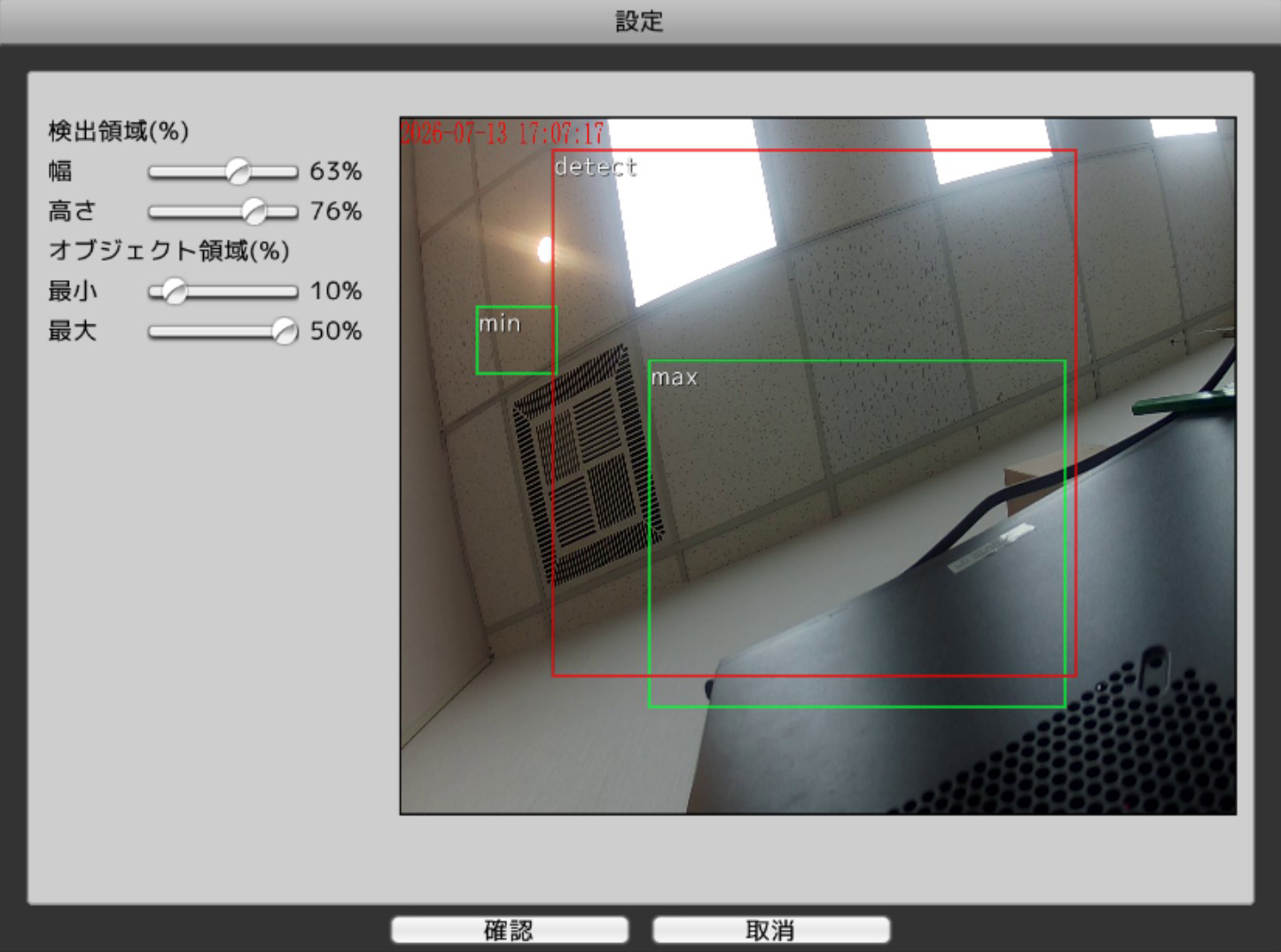
- Detection Area
- Maximum Detection Size
- Minimum Detection Size
Through these settings, recognition efficiency can be further improved while reducing false detections.
Are your products compliant with TAA (Trade Agreements Act)?
We can provide selected IP Camera and NVR models that support NDAA and TAA-oriented project requirements. The relevant information is as follows:
| Item | Description |
|---|---|
| Country of Origin (COO) | Taiwan |
| Chipset Architecture | Taiwan-based |
| Assembly Location | Taiwan, 2F, No. 48, Da'an St., Xizhi Dist., New Taipei City 221. |
| Factory Location | Taiwan, 2F, No. 48, Da'an St., Xizhi Dist., New Taipei City 221. |
| Software / Firmware Integration | Taiwan |
Since Taiwan is listed as a Designated Country under the U.S. Trade Agreements Act (TAA), products manufactured in Taiwan meet the country eligibility requirements for TAA compliance.
However, the final determination of NDAA and TAA compliance depends on the requirements of each project owner, procurement department, or reviewing authority. There is no single universal approval standard applicable to all projects.
What is the maximum HDD capacity supported by the 16CH DVR?
The 16CH DVR supports up to 18TB SATA HDD.
Based on the current platform architecture and H.265 DVR system design, the recorder supports high-capacity SATA storage devices up to 18TB, meeting the requirements for long-term video recording and storage applications.